The Truma Combi 4 is the smaller gas-only model in the Truma Combi family. Alongside it are the more powerful Combi 6, the Combi 4 E/6 E (gas/electric), the Combi D4/D6 (diesel) and the D4E/D6E (diesel/electric). If you are specifying a new motorhome or buying a used vehicle with a Truma Combi, sooner or later you will ask: what exactly can this heater do? What output does it have, how much gas does it use, how big is it, and how does the Combi 4 differ from the Combi 4 E?
This article gives you all the Truma Combi 4 specifications in full, with context rather than a bare data sheet. What does a rated heat output of 4000 watts mean in practice? How much gas does the heater use per night? And what is the real difference between gas and electric operation? All appliance figures come from Truma (product page and Combi operating instructions). Worked examples are marked as such.
Truma Combi 4 at a glance
| Specification | Value |
|---|---|
| Rated heat output (gas) | 2000 / 4000 W (two levels, selected automatically) |
| Gas consumption | 160–335 g/h (propane / butane) |
| Rated heat input to EN 624 | 4.8 kW or 345 g/h (based on the gross calorific value Hs) |
| Gas per night (worked example, 8 h) | approx. 1.3 kg (low level) to 2.7 kg (full load) |
| Water heater | 10 litres, stainless steel |
| Hot water heat-up time | approx. 23 minutes (from approx. 15 to 60 °C) |
| Dimensions (L × W × H) | 510 × 450 × 300 mm |
| Weight | approx. 14.4 kg (4 E: approx. 15.5 kg) |
| Current draw at 12 V | average approx. 1.2 A, briefly max. 6.5 A |
| Control panel | Truma CP Plus (TIN bus) or iNet X Panel |
What is the Truma Combi 4?
The Truma Combi 4 is a combined gas air and water heater. That is the core of its concept: one appliance does two jobs.
- Air heating: warms the air in the vehicle via a fan and a warm air duct system.
- Water heating: heats water in an integrated 10-litre stainless steel water heater.
This combination makes it compact and an obvious choice for small and medium-sized vehicles, which is exactly how Truma itself positions the Combi 4. You will find it in caravans, motorhomes and campervans from many manufacturers.
It is controlled from the digital CP Plus control panel, which communicates with the heater over the TIN bus, Truma's appliance bus based on LIN. Newer installations may have the iNet X Panel instead. The CP Plus is also the interface through which the Combi 4 can later be controlled by app (more on that below).
Truma Combi 4 specifications in detail
Heat output and operating modes
The key figure for any heater: how much heat can it produce?
- Rated heat output, gas: 2000 W or 4000 W
- Output levels: 2. In heating mode the Combi selects the level automatically, based on the difference between the set and the measured room temperature
- Summer mode (hot water only): lowest level at 2000 W, without the circulating air fan
- Air flow: max. 287 m³/h (free-blowing, with 4 warm air outlets)
What does that mean in practice? If the vehicle is still much too cold, the Combi 4 heats at 4000 W; close to the target temperature, at 2000 W. If the vehicle needs less than 2000 W to hold the temperature, the burner no longer runs continuously but switches off and on again. Truma intends the Combi 4 for small and medium-sized vehicles, so typically campervans and compact motorhomes. For larger caravans and motorhomes, Truma has the Combi 6 with a third level (6000 W).
Gas consumption
Day to day, gas consumption matters at least as much as heat output. Truma's figures:
- Consumption by level: 160 g/h (2000 W) to 335 g/h (4000 W)
- Rated heat input to EN 624: 4.8 kW or 345 g/h, based on the gross calorific value Hs. This is a standard figure from the appliance approval, not additional consumption
- Hot water only: the water heater is heated on the lowest burner level, so at 160 g/h while the burner runs. Once the water temperature is reached, it switches off. Worked example: heating 10 litres once from 15 to 60 °C in approx. 23 minutes ≈ 160 g/h × 23/60 ≈ 60 g of gas.
Worked example for a winter night (our own calculation based on Truma's figures): if the burner runs for eight hours non-stop on the low level, that is 8 × 160 g ≈ 1.3 kg of gas. Eight hours at full load would be 8 × 335 g ≈ 2.7 kg. Because the burner pauses once the temperature is reached, real consumption lies somewhere between these figures or below, depending on the outside temperature, the insulation and the temperature you set. By this calculation, an 11 kg bottle (the standard size in Germany) lasts a little over eight nights on the low level or about four nights at full load, provided you do not heat during the day. With a night setback (for example to 14–15 °C using the CP Plus time switch), consumption drops. How to set it: Running a Truma heater overnight.
The main lever for saving gas is running time. That is where the factory setup falls short: the CP Plus can only be operated inside the vehicle. If you forget to turn it down before heading out, you heat an empty camper all day. With an app control such as CampMatic you lower the temperature while you are out and only heat up again on your way back. At 160 to 335 g/h, that adds up noticeably over a winter season. How to retrofit it is in the section Operation and control below.
Important for winter: use propane rather than butane. The Combi 4 is designed for both gases (propane / butane, 30 mbar), but butane hardly vaporises in frost. The bottle is then still full but no longer delivers gas. Propane stays usable below zero. In the UK, Calor's red bottles are propane, the blue ones butane. Truma also advises running the gas pressure regulator with the EisEx regulator heater at temperatures around 0 °C and below.
Hot water
- Capacity: 10 litres
- Material: stainless steel (rust-free, durable)
- Water temperature: selectable on the CP Plus, 40 °C (eco) or 60 °C (hot). In heating mode, a filled water heater is heated automatically as well; the temperature then depends on the heat output
- Heat-up time: according to Truma approx. 23 minutes from approx. 15 to approx. 60 °C when only the water heater is heating. If the Combi heats the room and the water heater at the same time, Truma gives approx. 80 minutes
The 10-litre tank is comfortably enough for one person to shower. Two people one after the other is possible if you shower sparingly and leave the heater running. For families: let the heater make more hot water for a short while between two showers.
Dimensions and weight
- Dimensions (L × W × H): 510 × 450 × 300 mm
- Installation dimensions (minimum): 540 × 500 × 350 mm. Depending on the installation, add space for the gas and water connections
- Weight: approx. 14.4 kg (Combi 4 without water and without peripherals; with peripherals approx. 14.9 kg)
- Compared with the Combi 6: same external and minimum installation dimensions, same weight
Depending on the vehicle, the Combi 4 typically sits under a seat bench, in the wardrobe or at the rear under a service hatch: accessible, but out of everyday view. The CP Plus control panel is mounted in the living area.
Power consumption
- Operating voltage: 12 V DC
- Current draw in heating mode (heating + water heater): average approx. 1.2 A, briefly max. 6.5 A
- Heating the water heater only: max. approx. 0.5 A
- Quiescent current: approx. 1 mA
Worked example: eight hours of heating at an average of 1.2 A comes to around 10 Ah (8 × 1.2 A). A healthy leisure battery covers that without mains hook-up. According to Truma, the HIGH fan level increases the current draw.
Gas approval and standards
- Gas type: LPG (propane / butane), operating pressure 30 mbar
- Approval: type C13, appliance category I3 B/P (30) to EN 624. Heating while driving is permitted with a safety shut-off device to UN ECE R 122 (for example in the Truma MonoControl CS gas pressure regulator)
- Flue: combined combustion air/exhaust flue (room-sealed, using outside air)
Room-sealed operation matters for safety. The Truma Combi 4 draws its combustion air from outside through the outer pipe of the flue and releases the exhaust to the outside, so it does not use the air you breathe inside. That requires a clear, intact flue. Truma requires keeping it free of slush, ice and leaves, does not permit flue caps and specifies checking the double exhaust pipe regularly, especially after long journeys, for damage and a secure connection. In enclosed spaces such as garages or awnings, the exhaust gases can cause poisoning, according to Truma.
Truma Combi 4 vs Combi 4 E: what is the difference?
The Truma Combi 4 comes in two main versions that regularly cause confusion.
Combi 4 (gas only)
The basic version. It runs on gas only. All the specifications above apply to this version.
Combi 4 E (gas + electric)
The E version also has heating elements in the heat exchanger for electric operation. That allows three operating modes:
- Gas only: as on the Combi 4, 2000 or 4000 W
- Electric only: 900 W or 1800 W via the heating elements (230 V mains hook-up required), selected by hand to suit the fuse rating on the pitch
- Mixed mode, gas + electric: up to 3800 W in total. Electricity has priority; the gas burner only comes in when more output is needed. Mixed mode is only available for heating. In hot water only mode with this setting, the Combi automatically heats electrically.
Additional Combi 4 E specifications:
- Electrical connection: 230 V, current draw 3.9 A (900 W) or 7.8 A (1800 W)
- Electric output: 900 W (level 1) or 1800 W (level 2)
- Weight: approx. 15.5 kg (a little over 1 kg heavier than the gas-only version)
- Control panel: CP Plus or iNet X Panel. According to Truma, the CP classic control panel is not suitable for the Combi E
- If the hook-up fails: if the 230 V supply fails, the Combi 4 E switches to gas automatically
When is the E version worth it? For anyone who regularly stays on campsites with mains hook-up and wants to use electricity there instead of gas. For heating up or at low outside temperatures, though, Truma advises gas or mixed mode so that there is always enough output. On pitches without hook-up, the E version works exactly like the standard Combi 4.
Important when buying: the Combi cannot be converted to E. The heating elements are integrated into the heat exchanger at the factory and, according to Truma, cannot be fitted later. If you want to heat electrically, you have to choose the E version when you buy. More in Retrofitting a Truma Combi to E? Combi 4 vs 4 E and 6 vs 6 E compared.
Besides the Combi 4 and 4 E, the range also includes diesel versions: the Combi D4/D6 (diesel) and the Combi D4E/D6E (diesel/electric), which take their fuel from the vehicle tank.
Combi 4 vs Combi 6: when do you need more?
The Combi 4 is not the only heater in the range. The Combi 6 offers more output, but do you need it in a compact vehicle?
- Combi 6: 2000 / 4000 / 6000 W gas output, 160–460 g/h, 10-litre water heater, average current draw approx. 1.4 A, with the same dimensions (510 × 450 × 300 mm) and the same weight (approx. 14.4 kg)
- Combi 4: 2000 / 4000 W, 160–335 g/h, 10-litre water heater, average current draw approx. 1.2 A
For campervans and compact motorhomes, the Combi 4 is usually a good fit. Truma describes it as a heater “for small and medium-sized vehicles”, and the Combi 6 as one for “larger caravans and motorhomes”. As the dimensions, weight and water heater are the same, the deciding factor is mainly the output reserve. The third level of the Combi 6 delivers 6000 W, but then uses up to 460 g/h of gas; on the low level both use the same. In a compact vehicle, the extra output of the Combi 6 would hardly be usable in practice, because the space warms up quickly. In mixed mode, the E versions reach max. 3800 W (Combi 4 E) or 6900 W (Combi 6 E).
Operation and control: from CP Plus to app
The CP Plus control panel
As standard, the Truma Combi 4 is operated from the digital CP Plus control panel. The CP Plus talks to the heater over the TIN bus and handles all control functions: on/off, heating mode (air, water, both), temperature, fan level, timer and night setback.
The CP Plus is easy to use and reliable. Its one limitation: it only works on the spot, inside the vehicle. Without an add-on, remote control is not possible. No pre-heating on the way there, no check that everything is running in winter storage.
Truma iNet X system
Truma's own app solution: the iNet X Panel replaces the CP Plus and is operated nearby over Bluetooth with the Truma app. For remote access, Truma offers the iNet X Connect add-on module (according to Truma, two years included, then subject to a charge). The existing control panel is replaced in the conversion. Which heaters are approved for it is set out in Truma's compatibility list.
If you already have an iNet X Panel, there is a separate CampMatic box for it: CampMatic for Truma iNet X connects to the panel over Bluetooth, only needs power via a USB cable and has no firmware requirement.
CampMatic: add remote control without replacing anything
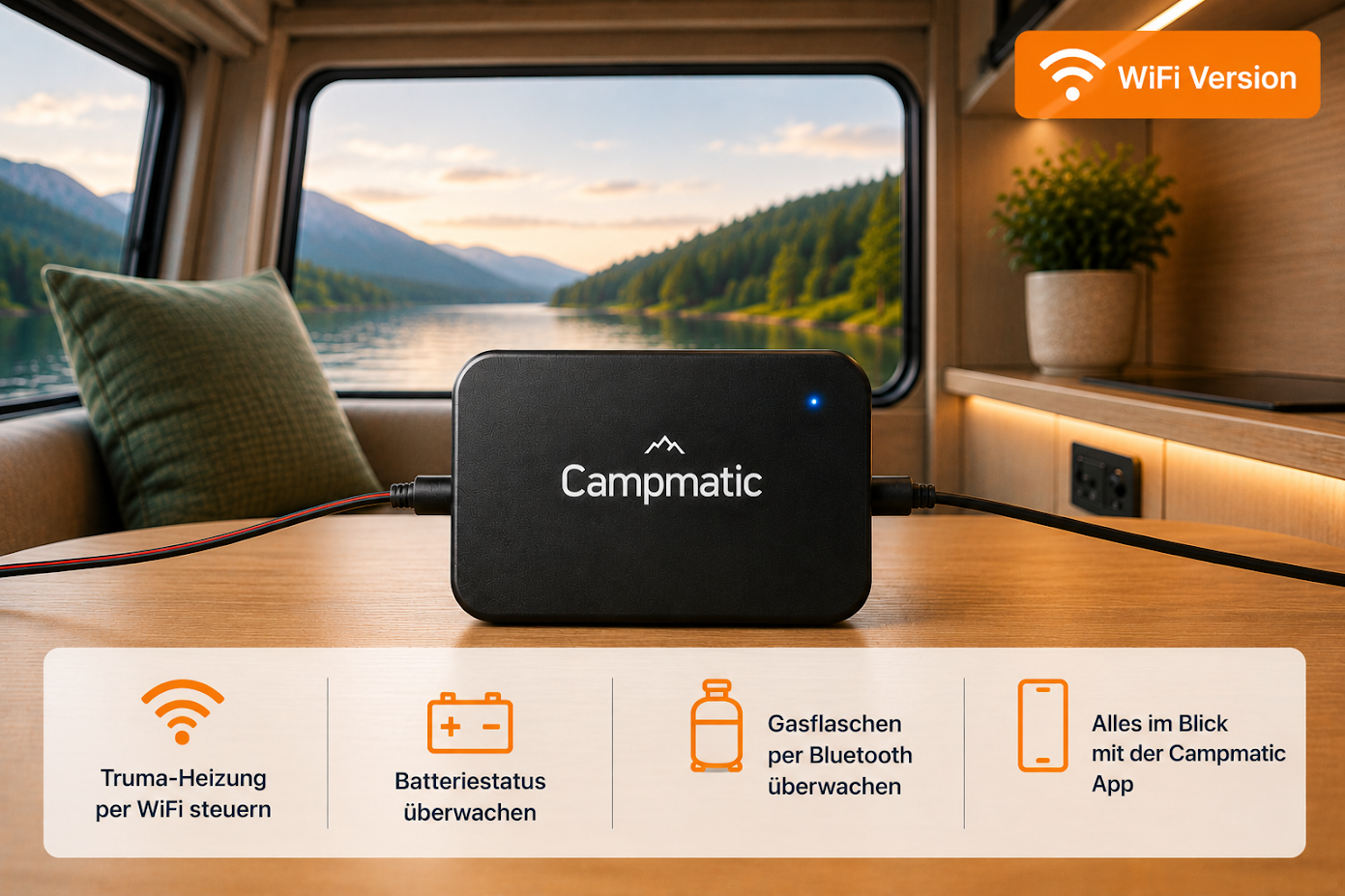
CampMatic is a slim add-on for the Truma Combi 4: a controller that plugs in via RJ12 between the CP Plus and the heater. Plug and play, under ten minutes, no tools, no work on the heater. The CP Plus stays fully in place and can still be used. It requires CP Plus firmware C4 or F4 (Vario Heat: P5). You can read it on the CP Plus under Settings → INIT: the panel's identifier then starts with C4 or F4, for example C4.xx.xx. More on this: Finding your Truma CP Plus software version.
What you can then do:
- Heater on/off and target temperature from anywhere: pre-heat before you arrive.
- Switch hot water separately: the 10-litre tank is warm when you need it, instead of a wait of around 23 minutes.
- Turn it down remotely: an effective way to save gas when the camper stands empty during the day.
- Frost warning by email and Telegram when the interior temperature drops below your threshold. In winter storage that is worth a lot.
- Status and temperature history live in the app, instead of driving to the vehicle to check.
- Home Assistant (MQTT): the Combi appears as a climate entity via auto-discovery, so you can use it in your own automations.
- Gas and battery monitoring included: with a Truma Level Control or Mopeka sensor you see the bottle level in the same app, with BM2 sensors the leisure battery. Handy if the consumption figures above were what interested you.
There are two versions to choose from, technically identical but connected differently:
- CampMatic for Truma CP Plus · WiFi (GC_HW01), €149: uses a WiFi network at the vehicle (hotspot, campsite WiFi, LTE router).
- CampMatic for Truma CP Plus · 4G (GC_HW_GSM01), €209: goes online over the mobile network and works with no WiFi on site.
With an iNet X Panel, the equivalents are CampMatic for Truma iNet X · WiFi (€149) and · 4G (€189).
CampMatic fits all compatible Truma Combi heaters, gas and diesel, with CP Plus firmware C4 or F4 (Vario Heat: P5) or with a Truma iNet X Panel, whatever the vehicle.
→ CampMatic for Truma · WiFi — control your Combi 4 by app, from €149
→ CampMatic for Truma · 4G — the same with no WiFi at all (+€60)
The box for the CP Plus: CampMatic for Truma CP Plus. All the ways to control the heater remotely: Control your caravan heater from an app.
Maintenance and operation: what you should know
Servicing
Truma does not give a fixed service interval for the appliance itself. According to the operating instructions, a qualified person should check the Combi for dirt and clean it if necessary. Repairs and cleaning of the appliance are a job for qualified staff. Two things you should do yourself: clean the installation space at least once a year, and operate the FrostControl valve at least twice a year so that it does not scale up or stick. In addition, the manual requires the LPG system to be inspected in line with national regulations (in Germany, every two years).
In practice: book a service before the first winter use or at the start of the season, and have the flue and the double exhaust pipe looked at as well. Money well spent, because a heater failure on a winter night costs a lot more.
For the hot water, Truma recommends regularly cleaning and disinfecting the water heater with commercially available products that contain no chlorine. To support this, you can bring the water up to 70 °C: select gas mode, set 60 °C and leave the heater switched on for at least 30 minutes after the temperature is reached, without drawing hot water.
Draining the water heater: frost risk and storage
If you do not use the vehicle when there is a risk of frost, Truma says you must drain the 10-litre water heater. Frozen water can damage it. This also applies if only the cold water system is in use, because the water heater fills up anyway.
It is drained via the FrostControl, a safety/drain valve that needs no power: switch off the power to the water pump, open the hot water taps and turn the rotary switch through 180°. The push button pops out, and the contents drain to the outside via the drain outlet. Then check that all 10 litres have really run out. If the temperature at the valve drops below approx. 3 °C, the FrostControl opens by itself. It can only be closed again above approx. 7 °C. You can still heat with an empty water heater, as room heating only with hot water off. Step by step: Draining a Truma Combi: FrostControl and hot water in winter.
Error codes
The Truma Combi 4 reports faults as an error or warning code on the CP Plus display. Some common codes:
- W 255 H: no connection between CP Plus and heater. Check the heater's 12 V supply (fuse) and the control panel cable
- E 516 H / E 517 H: gas fault. Check the gas bottle, valves and regulator. If the code is flashing, a 15-minute lockout is running. During that time, do not switch off the control panel and do not disconnect the power, otherwise the lockout starts again
- W 412 H / W 42 H: window switch warning. A window near the flue is open, and the heater switches off
According to Truma, the full list of codes is in the operating instructions of the control panel fitted. We have collected them in the list of Truma error codes. On the analogue CP classic, the Combi signals with LEDs instead: what the flashing light means.
The catch with these codes: you only see them when you are standing at the control panel. A fault in winter storage is often only noticed once the damage is done. With an app connection, you can see the heater's state remotely at any time. What else can be behind a fault: Truma heater not working? Causes and fixes for every Combi.
Truma Combi 4: frequently asked questions
How much gas does the Truma Combi 4 use per night?
According to Truma, the Combi 4 uses 160 to 335 g of gas per hour. Worked example for eight hours: non-stop on the low level about 1.3 kg, non-stop at full load about 2.7 kg. Because the burner pauses once the temperature is reached, real consumption lies between these figures or below, depending on the outside temperature and insulation. By calculation, an 11 kg bottle (the standard size in Germany) lasts a little over eight nights on the low level or about four nights at full load. Less with a night setback to 14–15 °C.
Combi 4 or Combi 4 E: which should I choose?
The 4 E is worth it if you regularly stay on hook-up and want to heat electrically there instead of with gas. Without hook-up it behaves exactly like the Combi 4, so you pay for a function you do not use. The electric part cannot be retrofitted, so the decision is made when you buy.
Can the Truma Combi 4 be controlled remotely?
Not with the CP Plus alone, because it only works inside the vehicle. You can add remote control with the Truma iNet X system (the control panel is replaced) or with CampMatic (installed in under 10 minutes, from €149). On the CP Plus, CampMatic plugs in between and the CP Plus stays. With an iNet X Panel, it is a separate box connected over Bluetooth.
Which CP Plus do I need for app control?
One with CP Plus firmware C4 or F4 (Vario Heat: P5). You can check this on the CP Plus under Settings → INIT. If the panel's identifier starts with C4 or F4, you are ready; on a Vario Heat it reads P5.xx.xx. With C3 the data can only be read, and control is not possible.
How long does the hot water take to heat up?
According to Truma, around 23 minutes to bring the 10 litres in the stainless steel tank from about 15 to 60 °C when only the water is heated. If the Combi heats the room and the water at the same time, Truma gives approx. 80 minutes. That is why starting it remotely by app is handy: the tank heats up while you are still on your way.
Does the Combi 4 fit every motorhome?
It is designed for small and medium-sized vehicles. The appliance measures 510 × 450 × 300 mm (L × W × H), and Truma gives 540 × 500 × 350 mm as the minimum installation dimensions. Whether that fits depends on the installation space in the vehicle. For a much larger living space, the Combi 6 is the better match. It has the same dimensions.
Summary: well sized, well built, easy to extend
The Truma Combi 4 specifications show a heating system well suited to compact and medium-sized motorhomes and campervans: two output levels up to 4000 watts, 160 to 335 g/h gas consumption, a 10-litre stainless steel water heater, approx. 14.4 kg at 510 × 450 × 300 mm and an average of only approx. 1.2 A on the 12 V system.
What the Combi 4 cannot do from the factory is remote control. The CP Plus is good, but tied to the vehicle. If you want to start the heater while you are out, turn it down during the day instead of heating an empty camper, have hot water on demand and get a frost warning in winter storage, CampMatic adds that in ten minutes. Plug and play, and the CP Plus stays. With an iNet X Panel, the CampMatic for Truma iNet X box does the job.
→ CampMatic for Truma · WiFi — from €149 · CampMatic for Truma · 4G (+€60)
Not sure your CP Plus is suitable? Check the version as described in Finding your Truma CP Plus software version, or drop us a line and we will check the firmware version with you.
Further reading: