In short: the Truma Combi draws its combustion air from outside and releases the exhaust gases into the open air through the flue. Heating with the vehicle closed up is therefore its normal mode of operation, at night too. For winter camping, Truma even advises that if there is a risk of frost and water remains in the system, the vehicle should not be allowed to cool down completely.
What matters is that you follow the rules in the operating instructions. There is no explicit Truma statement that it is "safe overnight". Below you will find what the manual requires, how much gas and power a night takes and how to lower the temperature at night.
At a glance
- Combustion separate from the living space: air comes from outside, exhaust leaves through the flue.
- Keep the flue clear: no slush, no ice, no leaves, no flue cap. Never heat in enclosed spaces such as a garage or awning.
- Gas per hour: Combi 4 (E) 160 to 335 g, Combi 6 (E) 160 to 460 g.
- Power: on average about 1.2 A (Combi 4) or 1.4 A (Combi 6).
- Night setback: with the time switch on the CP Plus or by app.
- Our recommendation: an alarm for gas and carbon monoxide as well.
How the Combi heats: air from outside, exhaust to the outside
The Combi draws its combustion air through the outer pipe of the combined flue. It releases the exhaust gases into the open air through the exhaust flue. The combustion chamber and the living space are kept separate, so the heater does not use room air for combustion.
For it to stay that way, the route to the outside has to be clear and sealed. That is what the next section is about.
What the manual requires
- Keep the flue clear: it must always be free of slush, ice and leaves. Check that it is clear before switching on, and remove any covers. Flue caps are not permitted.
- No enclosed spaces: in garages, workshops or awnings, the exhaust gases can cause poisoning. If you park the vehicle in an enclosed space: shut off the fuel supply, deactivate the time switch, and switch the heater off on the control panel and in the app.
- Check the exhaust pipe: check the double exhaust pipe regularly for damage and a secure connection, especially after long journeys.
- Flue below a window: if it is close to or directly below a window that can be opened, Truma requires an automatic shut-off via a window switch.
- Do not block the warm air: keep the outlets free and keep anything heat-sensitive or flammable away. On the Combi 6 (E), do not close any outlet completely; on the Combi 4 (E), close one at most.
- Have the gas system checked: the manual specifies a gas inspection every 2 years. Replace the regulator and hoses after 10 years at the latest.
Gas and CO alarms
We recommend fitting an alarm that detects gas and carbon monoxide (CO) as well. Truma points out that a gas alarm can increase safety but does not replace the gas inspection or servicing. Propane and butane are heavier than air; carbon monoxide behaves differently. So follow the manufacturer's instructions on where to place the alarm.
What temperature at night?
Truma does not give a recommended sleeping temperature. That is a matter of taste. On the CP Plus, you can set the room temperature from 5 to 30 °C in steps of 1 degree. Bear two things in mind:
- Do not let it cool down completely: if there is a risk of frost and water in the system, Truma says the vehicle should not cool down completely. To save gas, too, Truma advises keeping the heater running on a low setting rather than letting the vehicle cool right down.
- Mind the FrostControl: the valve stays closed as long as it is above about 3 °C there. If it sits far from the heater, the minimum setting of 5 °C may not be enough, so set it a little higher. More on this: Draining a Truma Combi: FrostControl and hot water in winter.
Combi D: not permanently on low load
On the diesel Combi, continuous operation at low load can lead to sooting. Truma therefore advises avoiding it and heating up to a high setting regularly.
How much gas, diesel and power a night takes
The figures from Truma's technical data:
| Model | Output levels | Consumption |
|---|---|---|
| Combi 4 (E), gas | 2000 / 4000 W | 160–335 g/h |
| Combi 6 (E), gas | 2000 / 4000 / 6000 W | 160–460 g/h |
| Combi D 4 (previous generation) | 2000 / 4000 W | 220–452 ml/h |
| Combi D 6 | — | 220–630 ml/h |
| Combi D 4 E (new generation) | 1000–4000 W | 0.1–0.4 l/h |
Worked example (our calculation): if a Combi 4 ran for eight hours non-stop on its 2000 W level, that would be about 8 × 160 g ≈ 1.3 kg of gas. In practice the heater cycles on and off. Actual consumption depends on the outside temperature, the insulation and the temperature you set.
Power from the leisure battery
- Combi 4 (E): about 1.2 A on average, briefly up to 6.5 A.
- Combi 6 (E): about 1.4 A on average, briefly up to 6.5 A.
- Combi D 4: 1.8 to 4 A, below 1.8 A in normal operation.
- CP Plus in standby: 6.5 to 10 mA.
Worked example: eight hours at an average of 1.2 A comes to about 10 Ah. After switching off, the circulating air fan keeps running for a while. This protects against overheating and cannot be switched off.
Tip for a quiet night: choose a lower fan level at night. According to the manual, HIGH means higher power consumption and a higher noise level.
Night setback with the time switch on the CP Plus
To lower the heating at night, use the time switch on the CP Plus:
- Enter a start and end time for the time window, for example for the night.
- For that window, choose the room temperature, hot water level, fan level and, where available, the energy type.
- Activate the timer (ON). The symbol flashes while the timer is active.
Outside the window, your normal settings apply. The timer stays active, even over several days, until you switch it off (OFF). After a power interruption you have to set it again.
Caution: an active timer switches the heater on even when the vehicle is parked, for example in a garage. There is a risk of poisoning there. Deactivate it beforehand.
Lower it at night and pre-heat in the morning by app
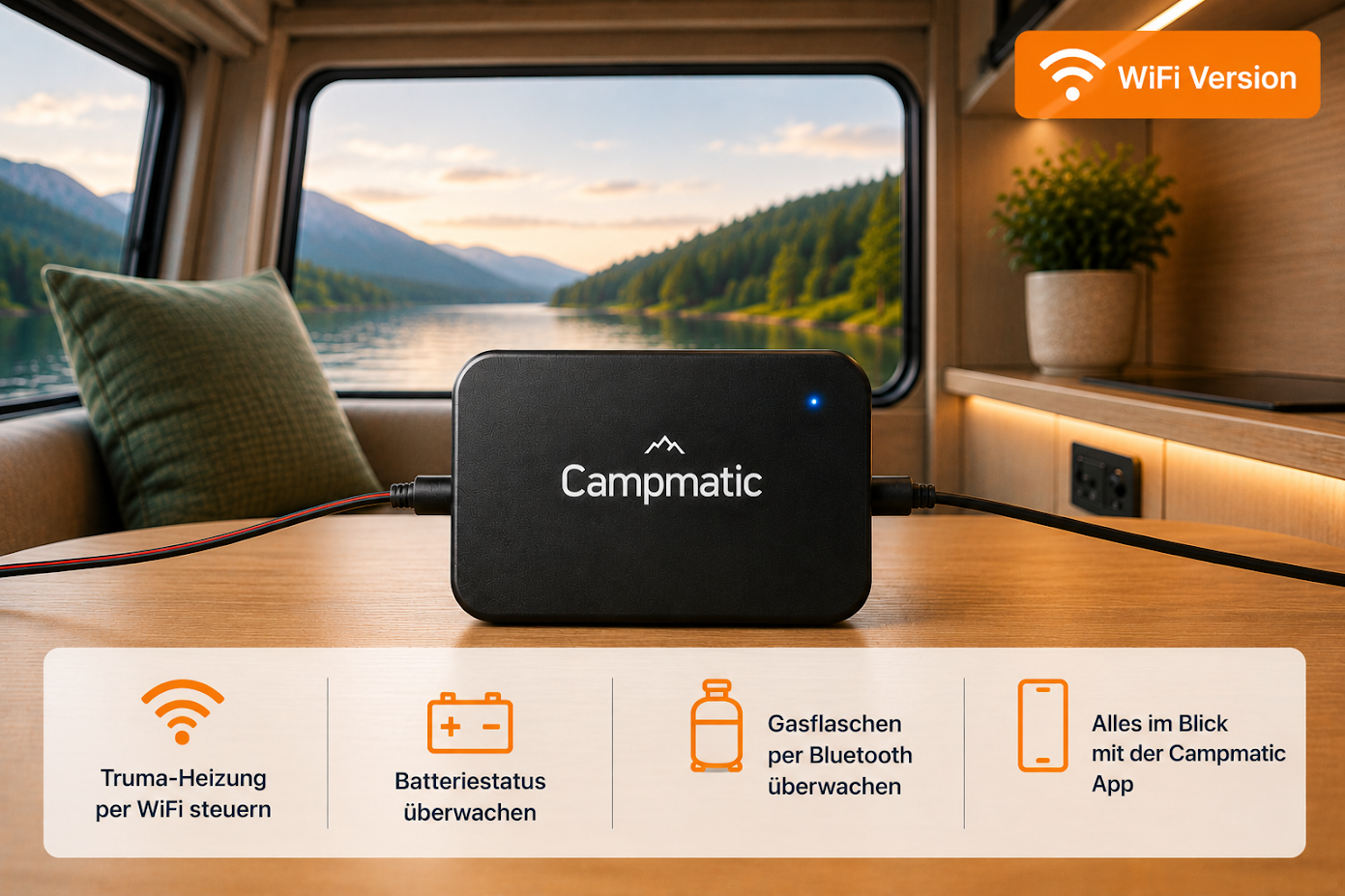
With CampMatic for Truma CP Plus or CampMatic for Truma iNet X you can do this without the panel menu:
- Turn it down from bed: lower the temperature in the app without getting up.
- Warm in the morning: a timer in the app pre-heats for when you get up. You can change it at any time, even when you are away.
- Room temperature in view: if the room temperature drops below your limit, you get a notification via push or Telegram. Whether the heater has gone into fault mode, you see as soon as you open the app.
- Gas in view: with a Truma Level Control or Mopeka under the bottle, you see the level and get a message in good time.
This works with all compatible Truma Combi heaters, gas or diesel, with or without E, and with the Vario Heat. On the CP Plus you need firmware C4 or F4, P5 on the Vario Heat. On the iNet X Panel there is no firmware requirement.
Frequently asked questions
Can I leave my Truma heater on overnight?
The Combi burns air from outside and releases the exhaust through the flue. Heating with the vehicle closed up is its normal operation. Follow the rules in the manual: flue clear, exhaust pipe sealed, no enclosed spaces, gas system inspected.
How much gas does a Truma heater use per night?
The Combi 4 uses 160 to 335 g an hour, the Combi 6 160 to 460 g. Eight hours non-stop on the 2000 W level would be about 1.3 kg. In practice it depends on the cycling, the outside temperature and the insulation.
What temperature should I set at night?
Truma does not give a sleeping temperature. With frost and water in the system, the vehicle should not cool down completely. Make sure it stays above about 3 °C at the FrostControl.
Do I need a CO alarm in my caravan?
We recommend an alarm for gas and carbon monoxide as an addition. It does not replace the gas inspection or servicing.
How much power does a Truma Combi use overnight?
At an average of 1.2 A (Combi 4), eight hours come to about 10 Ah, a little more for the Combi 6.
→ CampMatic for Truma CP Plus · WiFi — €149
→ CampMatic for Truma CP Plus · 4G — €209
→ CampMatic for Truma iNet X · WiFi — €149
Further reading: