Your camper is parked up in winter storage, deregistered, 150 km away on a farm or in a barn. You can't just pop over to check on it. And it's exactly during this idle season — October to March — that the expensive mishaps happen: one hard frost night, and the boiler or a water pipe bursts. The onboard battery slides unnoticed into deep discharge over the weeks. Or the frost guard quietly burns gas until the bottle runs dry.
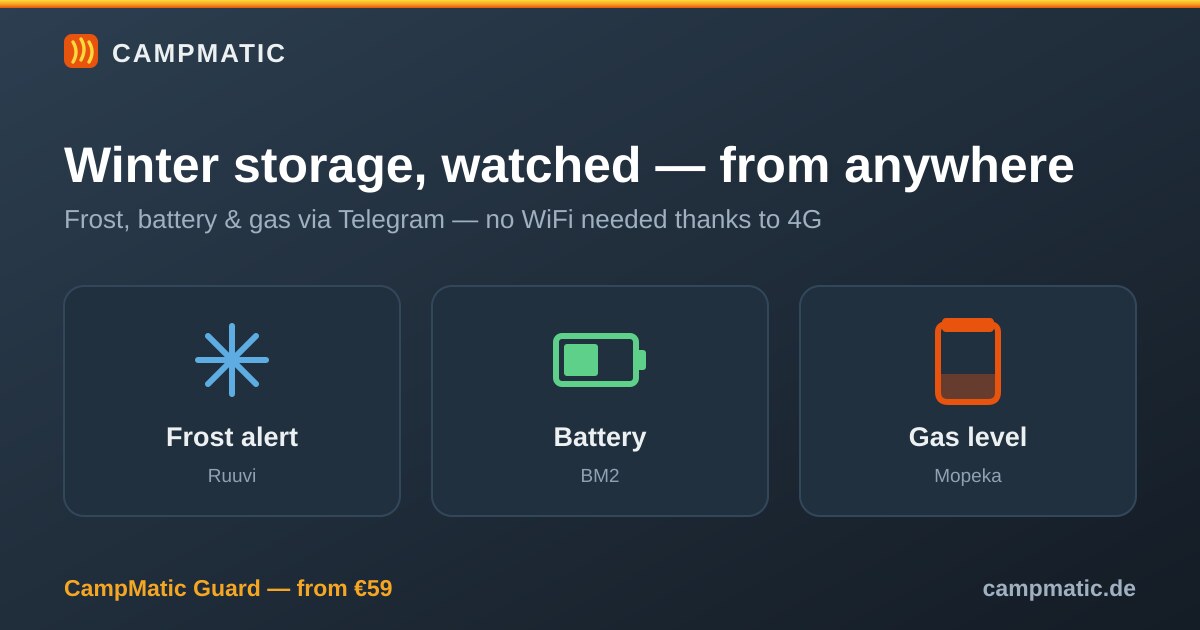
The frustrating part: all of this announces itself in advance. You only need to find out in time — remotely, without driving over every weekend. That is exactly what CampMatic Guard is built for. A small device in the camper, three sensors, and you have frost, battery and gas on your phone all winter long.
The three dangers of the idle season
A stored vehicle is not "safe because it's parked". Quite the opposite — nobody is around to step in. Three things regularly cost winter campers nerves and money:
- Frost — residual water in the boiler, pipes or heater freezes, expands and cracks components. Repairs quickly run into the hundreds.
- Onboard battery — even parked up, the electrics draw a standby current. Over the weeks a battery slides into deep discharge and takes permanent damage. A new AGM or lithium battery is expensive.
- Gas — anyone keeping the camper above freezing with a frost guard or a small gas heater is burning gas. If the bottle runs empty, the frost protection fails — at the worst possible moment.
The good news: there is a matching sensor for each of these dangers — and CampMatic Guard brings them all into one app and one Telegram alert.
Danger 1: frost — the RuuviTag warns before it's too late
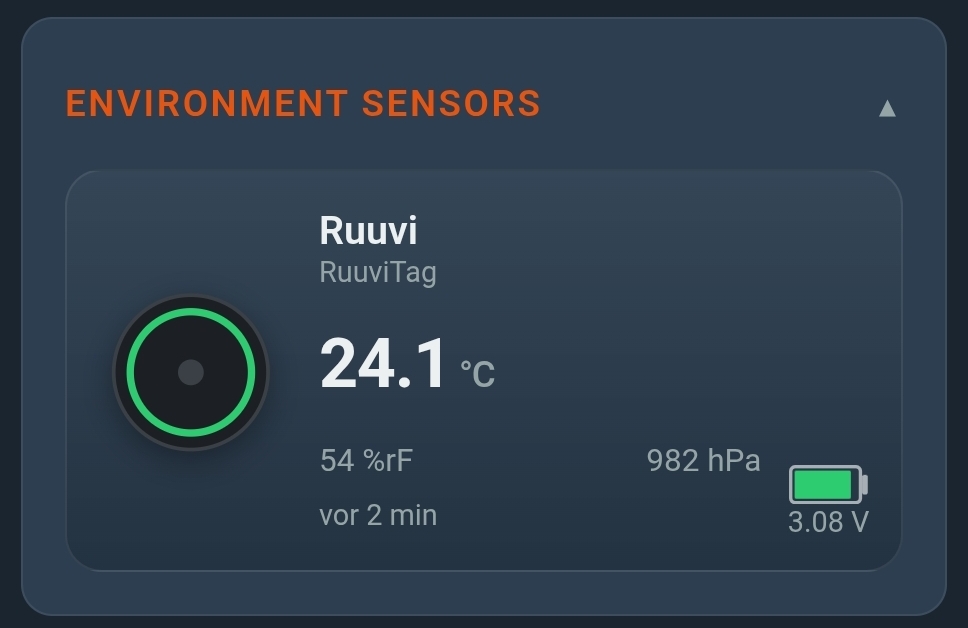
A RuuviTag measures temperature and humidity accurate to ±0.2 °C. You place it where it gets critical — near the boiler and water pipes. CampMatic Guard reads it over Bluetooth and sends the values to the cloud.
Now you set a threshold, say +3 °C. If the inside temperature drops below it, you get an instant Telegram and email alert — that is, before anything even freezes. That gives you a head start to react: ask someone to turn up the heating, or drive over the next day and drain the system yourself. No nasty surprise in spring.
The RuuviTag measures humidity alongside. With a camper standing idle for months, that is worth its weight in gold: if humidity climbs steadily, that is the early-warning sign for mould and damp stains. You see it on the history chart long before you smell it. The coin cell in the RuuviTag lasts for years, by the way — pop it in once and forget it.
Danger 2: onboard battery — the BM2 prevents deep discharge
The BM2 clips straight onto the onboard battery and measures voltage and state of charge (SoC). In the CampMatic app you see the history over 24 hours, 48 hours, 7, 30 or 90 days — perfect for the long idle season, when the curve moves only slowly.
The decisive part is the undervoltage warning. If the battery slides below your threshold over the weeks, Guard pings you on Telegram before a weakening battery becomes a deep-discharged and permanently damaged one. You can then arrange a targeted top-up or fire up the charger — instead of standing in front of a dead battery in spring.
Several batteries in the camper? No problem: Guard supports 1..n BM2 sensors, each battery as its own tile with its own history.
Danger 3: gas — the Mopeka keeps an eye on the fill level
If you heat against the frost with gas over winter, you should know how much is left. The Mopeka Pro Check measures the fill level by ultrasound from outside, on the bottom of the bottle — for steel and aluminium bottles as well as fixed tanks. No conversion, no touching the gas system.
So you see remotely how the bottle empties over the weeks and can swap or switch over in good time — before the frost protection fails for lack of gas. Again: 1..n sensors, each bottle individually.
The 4G angle: there is no WiFi in winter storage
And now the point where many solutions fall down: in winter storage, in the barn or on the storage lot, there is no WiFi. Your home WiFi is no help when the camper is parked 150 km away. Any monitoring that strictly needs WiFi is simply offline — precisely when you need it.
That is why there is the CampMatic Guard 4G (CM_LC_GSM01, €89): it goes online over the mobile network with its own SIM card — completely without WiFi, across Europe. Any SIM without a PIN works; an IoT SIM is available from around €2 a month. So frost, battery and gas alerts reach you reliably even from the most remote storage lot.
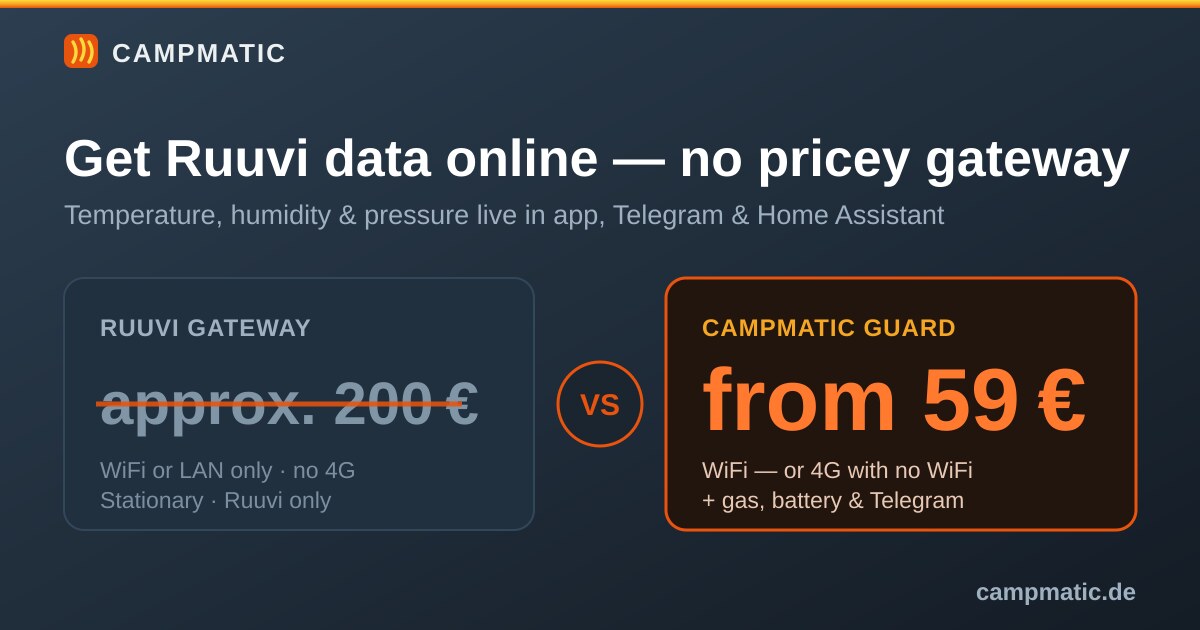
If, on the other hand, your camper sits at home in the driveway or in a barn with WiFi, the Guard WiFi (CM_LC_01, €59) is enough — it connects over WiFi (2.4 GHz). Both are functionally identical; the only difference is how the device gets online.
Power and cold: can the Guard take it?
A fair question for a solution that itself hangs off the onboard battery. Guard runs on 12 V or USB and needs very little: under 1 W (WiFi) or under 1.5 W (4G). That is so little that it barely loads the very battery it monitors — and thanks to the BM2 you see its own consumption anyway. The operating temperature range runs from −20 to +50 °C, so it comfortably covers a Central European winter.
How you get the alerts
- Telegram bot — a push to your phone on frost alarm, undervoltage or when the box goes offline. Query by command any time.
- Email — the same alerts additionally by email.
- CampMatic app (PWA) — all sensors as tiles with live values and history charts, no app-store install needed.
- Home Assistant & ioBroker — via MQTT auto-discovery all values land in your smart-home hub, if you run one.
What you need — and what isn't included
Guard is heater-agnostic: it monitors frost, battery and gas entirely independently of which heater or vehicle you have. All you need is the Guard device and the sensors for the dangers that concern you.
Important: the sensors are not included. As rough guides: a RuuviTag runs around €30–50, a BM2 around €15–25, a Mopeka Pro Check around €40. You buy only what you actually want to monitor — and can add more at any time later.
Conclusion
The idle spell in winter storage is the riskiest time in the camper year — and the one when you look in least often. Frost, deep discharge and an empty gas bottle all announce themselves; you just have to notice. CampMatic Guard from €59 brings the RuuviTag, BM2 and Mopeka into one app and warns you on Telegram before anything breaks. And with the 4G variant from €89 it works even where there is no WiFi — that is, exactly in winter storage.
→ CampMatic Guard WiFi (CM_LC_01) — monitor frost, battery & gas, €59
→ CampMatic Guard 4G (CM_LC_GSM01) — the same with no WiFi at all, ideal for winter storage, €89
Not sure which sensors you need for your camper? Check the help or write to us — we are happy to help you choose.